
BUILD JOURNAL: PART ONE
David Feetham went for a flight simulator experience after retiring. A few years later, he’s building a fully enclosed, dual-control Cessna 172 simulator on a six-degree-of-freedom motion platform — and planning to turn it into a business.
There is a point in this hobby where the words “I could probably build that myself” can become quite dangerous, and for David, it happened after he retired.
He’d been given a flight simulator experience in Wakefield as a gift. It was a static simulator; he thoroughly enjoyed it and, like many of us probably would, came away wondering whether he could create something similar at home.
Then came the bit we particularly like – “The more I looked into it, I thought if I was going to do this then I might as well do it properly — which meant a motion platform.”
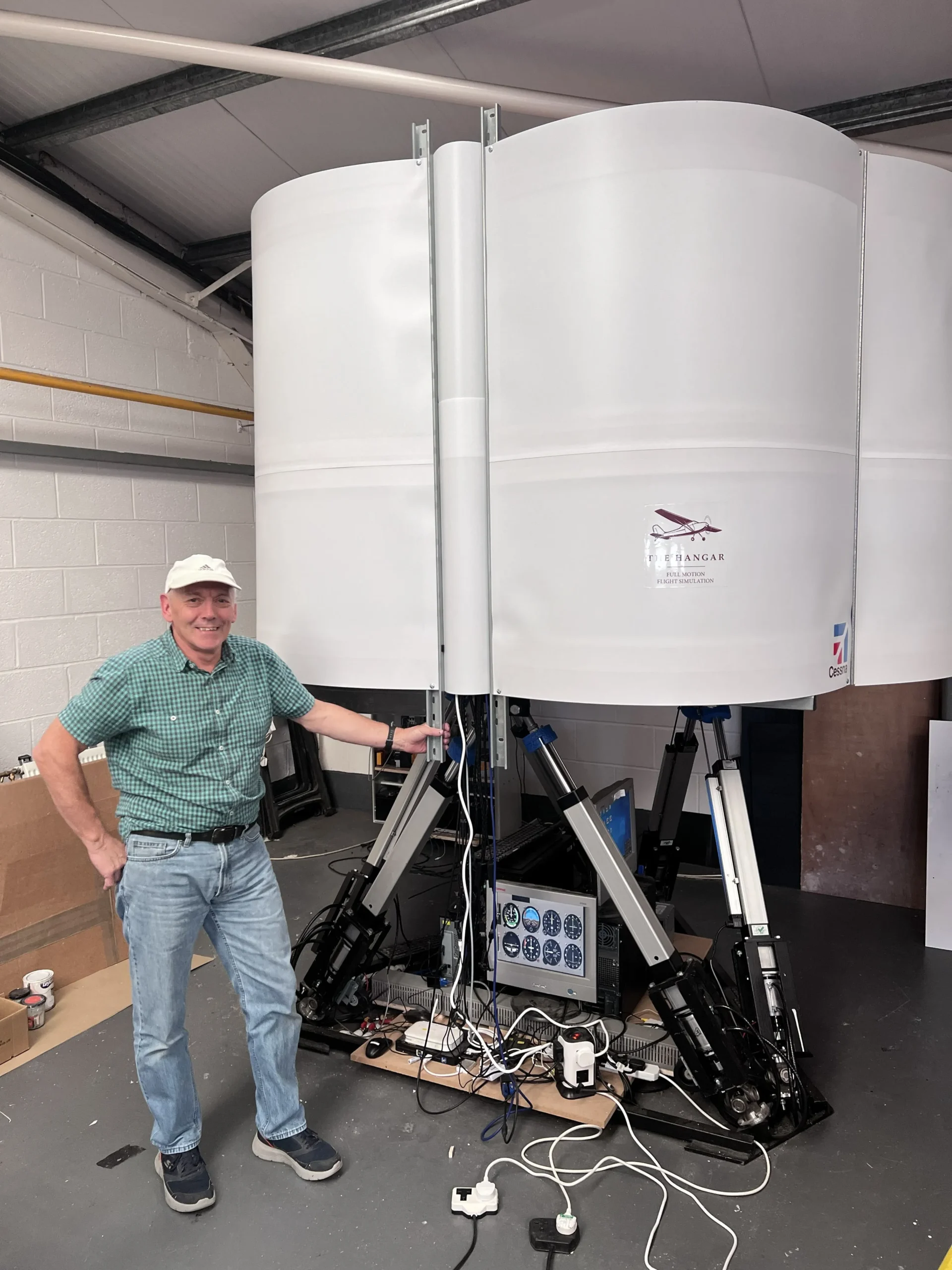
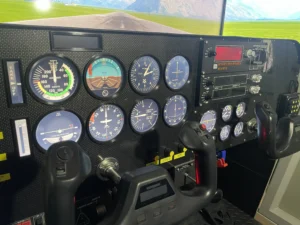
What followed has become a fully enclosed, dual-control Cessna 172 simulator sitting on a six-degree-of-freedom (6DOF) Stewart motion platform, surrounded by three 4K displays positioned to provide approximately 180 degrees of outside view.
Look at the photographs during construction and you begin to appreciate the scale of it.
This isn’t a gaming chair that moves around a little when you bank the aircraft.
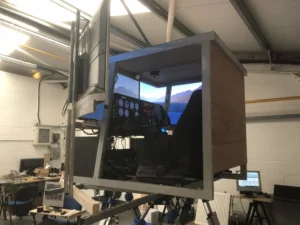
Beneath the cockpit is a substantial mechanical platform with six actuators controlling its movement. Around and above it, David has built the enclosed cockpit and visual system, with cosmetic shrouding gradually transforming what began as a fairly serious-looking engineering project into a self-contained simulator.
Perhaps the engineering background explains a few things. David’s route into building flight simulators isn’t quite what we expected either. His career started as a Radio Officer with BP Shipping before he spent 18 years working in biomedical engineering for the NHS, followed by another seven years in IT services.
The aviation interest, however, goes much further back.
As a teenager, he was an Air Cadet and had intended to join the RAF as a technician apprentice during the late 1970s. Defence cuts changed those plans and eventually took his technical career in a completely different direction.
Several decades later, aviation and engineering have rather unexpectedly found their way back together. With a couple of friends providing space in their industrial unit, what started as David’s idea for a home simulator has gradually developed into something bigger.
The intention now is to turn it into a small commercial operation, with David currently hoping to launch in the New Year.
“We can’t compete with the high-tech motion platforms used by the airline training organisations, but our platform is very immersive and we can land just about anywhere!” – And that last bit probably tells you quite a lot about the project.
The simulator currently runs X-Plane, with three 4K displays forming the outside view — one directly ahead and another to either side at approximately 60 degrees.
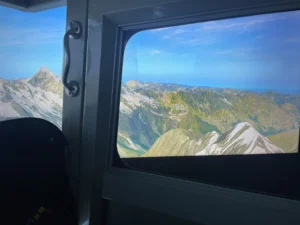
David’s own favourite place to fly is New Zealand.
“I particularly enjoy flying in the mountains in New Zealand where the scenery is fantastic.”
Looking at the photographs he sent us, we can understand why but it’s actually what happens next that interests us most.
David originally contacted the FSimUK team after reading about the Community Spotlight we’re creating inside the Community Hub at FSimUK.
He wasn’t contacting them with a finished product.
He wasn’t asking for a stand to sell something.
He simply wondered whether there might be a way of telling people about the project and allowing anyone interested to follow what happens as it moves towards launch.
The email was passed to us because AvGeekHangar is running the Community Spotlight – And within a couple of emails we’d decided that putting David’s project into a newsletter wasn’t really enough.
This is precisely why Community Spotlight exists. There must be hundreds of people around the UK building things, developing software, starting small businesses or simply trying something interesting within flight simulation that most of us know absolutely nothing about.
We want to find some of them before everybody knows their name.
More importantly, we don’t only want to turn up when the finished product is ready and there’s a press release to publish, as sometimes the journey is the interesting bit.
So we’re following this one. This is Part One.
David has given us our first look at the simulator, told us how it started and shown us just how far the project has already come. Now we want to know how you actually build something like this.
What’s been the hardest part?
Why a Cessna 172?
What does a six-axis motion platform genuinely add when you’re sitting inside it?
What has gone wrong along the way? And at what point did a retirement project become something David thought other people might actually pay to experience?
We’ve sent him some questions.
Those answers will form Part Two of our Build Journal, where we’ll get much further underneath the project — quite literally — and find out more about the engineering, the decisions behind the simulator and what still needs to happen before it is ready for its first customers.
Then, as the project approaches its planned launch in the New Year, we’ll come back again. Hopefully by then there will be a finished operation to introduce you to, and perhaps we’ll have to find an excuse to go and fly it ourselves.
Because sometimes the most interesting part isn’t seeing the finished simulator. It’s seeing how somebody got there.
Are you building something the flight-sim community should know about?
Community Spotlight is AvGeekHangar’s space for UK builders, developers, start-ups, communities and people working on interesting ideas within flight simulation and aviation.
You don’t need to have a finished product. In fact, we’d quite like to find you before you do.
Come and tell us what you’re working on.