
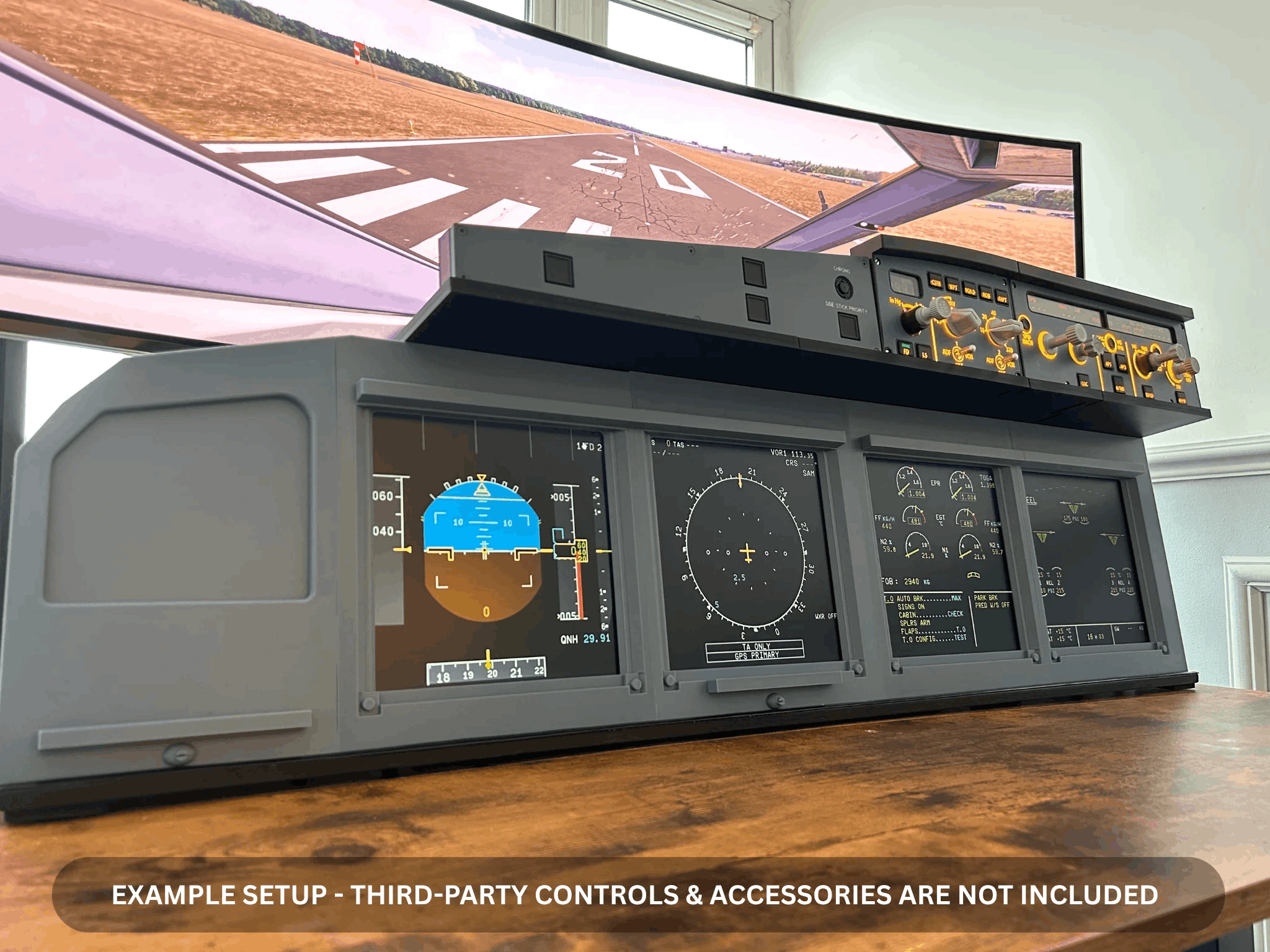
DesktopCockpits designs and produces pre-assembled desktop flight-simulator cockpits for Microsoft Flight Simulator and X-Plane 12.
Building a home simulator can sometimes feel overwhelming, expensive and time-consuming. Many flight simmers also need their desk for work or everyday use, so they cannot dedicate an entire room to a permanent cockpit.
DesktopCockpits offers a clean, compact solution designed to integrate with selected third-party flight-simulation hardware. The aim is to remove much of the building and assembly work, allowing people to set up their cockpit when they want to fly and pack it away again when they need their desk back.
I was inspired by some of the amazing home cockpits people had created, but I quickly realised that I didn’t have the space for a permanent, full-size build. I also work from home and need my desk during the day, so taking over the room with a cockpit simply wasn’t viable.
I started looking for a desktop cockpit that resembled an Airbus, but I couldn’t find anything that offered the balance of immersion, practicality and convenience I wanted. Eventually, I thought: “Perhaps I could build one myself.” After several months of designing, learning and plenty of trial and error, the first DesktopCockpit was born.
Having experienced how much work was involved, from learning the design software and 3D printing to assembly and finishing, I realised that other flight simmers might want something similar, without necessarily having the time or equipment to build it themselves.
I listed the first version on Etsy expecting that I might receive one order a month. I sold 12 in the first month, which was the moment I realised that this could become something much bigger than my own simulator project.
For me, it’s the realism and the feeling of getting as close as possible to being inside the real aircraft.
At the age of 16, I learned that my colour vision deficiency meant that I wouldn’t be able to pursue my dream of becoming a commercial airline pilot. Flight simulation became a way for me to remain connected to that ambition, and building a cockpit is the closest I will get to flying an airliner.
That is what continues to motivate me – every improvement to the cockpit adds another layer of immersion and makes the experience feel a little more real.
Absolutely, that is one of the main reasons DesktopCockpits exists.
I use my desk every day, so I couldn’t allow a cockpit to take over the entire room, although part of me certainly wishes I could! I wanted to show that greater immersion doesn’t necessarily require a permanent, full-scale build.
Building your own cockpit can be incredibly rewarding, and I have huge respect for the people in the community who do it. However, not everyone has the time, tools or confidence to design and build everything themselves. Some people simply want a clean, ready-made solution that allows them to spend more time flying. That is where DesktopCockpits can help.
I began with the Airbus A320 family, initially focusing on the Captain’s side and designing the cockpit to integrate with selected third-party hardware that many flight simmers already use.
Most recently, I launched the complete Airbus range, offering several sizes to suit different desks and setups, along with the long-awaited First Officer configurations. One of the things I’m particularly proud of is the amount of development and testing that went into creating eight distinct cockpit configurations for the new range.
The process has involved far more than designing the cockpit itself. There are product descriptions, compatibility testing, packaging and international shipping to consider, alongside actually manufacturing each unit.
One of the greatest technical challenges has been achieving the surface finish I want from 3D printing. Producing large panels consistently requires a great deal of calibration, testing and fine-tuning. It can be frustrating when something fails after hours of printing, but seeing the fully assembled cockpit at the end makes it worthwhile.
I would say most of the project has involved learning as I’ve gone along. When I started, I didn’t know how to design a product, I didn’t know how to 3D print, and I had certainly never designed a cockpit before.
I remember spending nearly a month just trying to achieve the quality and surface finish I wanted. I came very close to giving up at that point, but I persevered and eventually started getting the results I had been working towards.
Some lessons only became apparent in the real world. One of the earliest designs didn’t cope with international shipping as well as expected, which forced me to rethink both the construction and packaging. Since then, every cockpit has been designed with international shipping in mind, with the aim of ensuring it arrives safely wherever in the world it is going.
There have been plenty of failed prints and prototypes along the way, but each one has taught me something and helped make the finished product better.
The community has been incredibly important. Without seeing the amazing setups that other flight simmers had built and shared, I probably would never have been inspired to create my own cockpit in the first place.
Since launching DesktopCockpits, feedback and suggestions from the community have also helped shape what I develop next. The recent First Officer configurations are a great example. I received a growing number of requests from people who preferred flying from the right-hand seat, so I listened to that feedback and developed a dedicated First Officer range.
I don’t want to design products in isolation. The people using these cockpits often have brilliant ideas and very different setups, so listening to them helps me understand what the community actually wants rather than simply assuming.
I would tell them not to become overwhelmed by the finished cockpits they see online. Many of those setups have developed gradually over several years. Start small, break the project down into manageable stages and plan your ideas on paper first.
I would begin by asking:
There are some fantastic flight-simulation groups and communities online, so don’t be afraid to ask questions and draw inspiration from what others have created. Most importantly, enjoy the process. Once it’s finished, share it with the community and you might inspire somebody else to begin their own build.
What began with the modest hope of receiving one order a month has already grown into something much bigger than I could have imagined. It means a great deal that people within the community continue to trust me to provide such an important part of their simulator setup.
There is still a long runway ahead, with more aircraft, configurations and ideas I would love to explore. Ultimately, my ambition is for DesktopCockpits to become the home of desktop flight-simulator cockpits – the name people think of when they want greater immersion without needing the space, cost or complexity of a permanent full-scale build.
As the business grows, I want to retain what made it special in the first place: practical products developed by a flight simmer, shaped by feedback from the community and built with genuine care.
At the main DesktopCockpits stand, visitors will be able to explore the range in person and try two fully operational desktop simulator setups. I’m particularly excited to showcase the new Airbus range, including the recently launched First Officer configurations, alongside our new Boeing 737 range.
Over in the Community Hub, the DesktopCockpits showcase will focus more on the founder journey and the story behind the business, with a selection of cockpits available for visitors to examine up close.
People are welcome to talk to me about everything from choosing and setting up a home cockpit to configuring instrument displays, product development, 3D printing and the journey behind DesktopCockpits. Most importantly, I’m looking forward to meeting other flight simmers, hearing about their own setups and gathering ideas about what the community would like to see next.
The best thing about flight simulation is how immersive it can be. I remember sitting with a Logitech joystick playing Flight Unlimited II, and even that felt real to me at the time. When you look at the incredible simulators and hardware available today, it really does feel like we’re living through one of the most exciting times for flight simulation.