
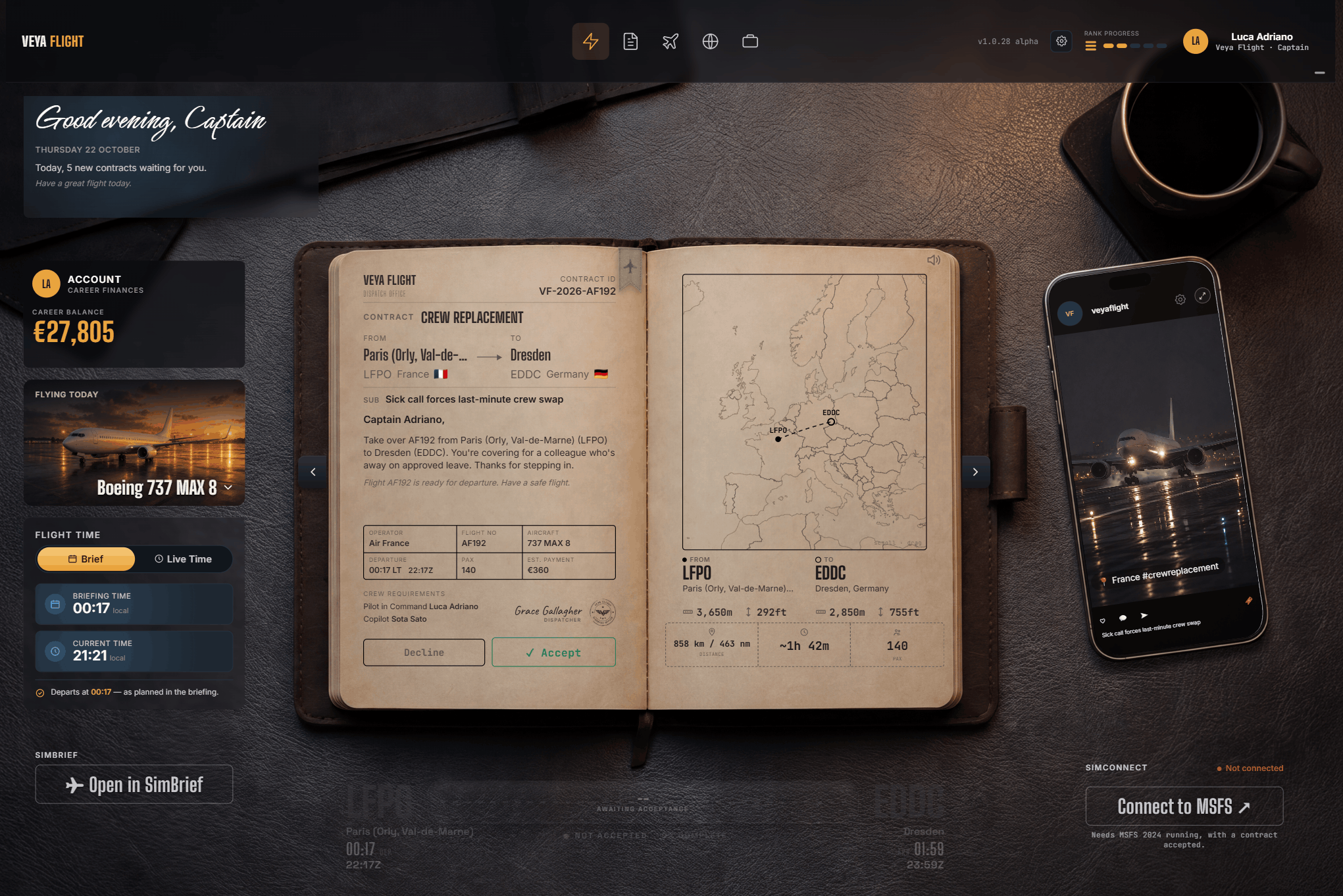
Inspired by a childhood computer game and the simple frustration of not knowing where to fly next, independent developer Ghost Dragon has created Veya Flight, a free companion for Microsoft Flight Simulator that brings contracts, destinations and a little storytelling into the virtual cockpit.
We’ve probably all experienced it at some point. You have an evening free, Microsoft Flight Simulator is ready to go, you’ve got a collection of aircraft you enjoy flying, but you find yourself staring at the world map wondering where to go. With thousands of airports available and almost unlimited possibilities, deciding what to do next can sometimes be surprisingly difficult. It’s something that independent developer Ghost Dragon knows particularly well, and it was this experience that eventually led him to create Veya Flight.
Originally from southern Poland and now living in Bayreuth, Germany, Ghost Dragon returned to Microsoft Flight Simulator after settling into life in Bavaria. Like many of us, he began with smaller aircraft before gradually moving towards airliners, learning their systems and procedures and spending countless hours getting to grips with the more demanding aspects of flying.
Over time, however, he found himself looking for something beyond the flight itself. He wanted a reason to travel somewhere, a purpose behind the next departure and perhaps a little more continuity between the journeys he was making. “One evening, I was sitting in front of the simulator’s map. I moved it around the screen, stopping at airports before moving on again. Eventually, I closed the map. I had no idea where I wanted to fly.” It was at that moment that he remembered Airline Tycoon, a computer game he had enjoyed during the late 1990s. The game combined airline management, contracts and a rather unusual sense of humour, but what stayed with him was the satisfaction of choosing a job and having somewhere specific to go. Someone needed a flight completing, and the player had a reason to take it on.
That simple idea became the starting point for Veya Flight. A Contract, a Destination and a Reason to Fly Veya Flight is designed to work alongside Microsoft Flight Simulator, giving virtual pilots access to contracts and assignments that provide a purpose for their flying.
Rather than simply selecting two airports and creating a flight plan, users can choose a job and become part of a wider journey. For Ghost Dragon, one of the most important aspects of the application is the ability to travel without knowing exactly where the next contract might take you. Veya offers different approaches to flying, including the option to explore destinations around the world or follow a continuous journey through its Linear Flight mode. With the latter, the next flight begins where the previous one ended, allowing pilots to gradually make their way across the world rather than repeatedly returning to a familiar departure airport. It’s an idea that has led Ghost Dragon to discover places he might otherwise never have considered visiting.
He recalls flying into regional airports in Azerbaijan and discovering that some of the procedures and local operating practices felt quite different from those he had become accustomed to at larger international hubs. The aircraft might have been familiar, but the experience of arriving somewhere new was not. “What I love about Microsoft Flight Simulator is that there is a real world behind the screen. Mountains, cities, coastlines and small airports I had never heard of before. Sometimes I fly somewhere simply because another contract takes me there. I discover the rest along the way.” That sense of discovery is central to Veya Flight.
Ghost Dragon doesn’t want to replace the freedom Microsoft Flight Simulator provides, but to help pilots make more use of it by giving them a reason to visit places they might otherwise overlook.
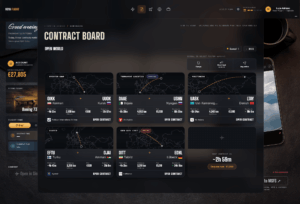
One of the more interesting aspects of Veya Flight is the freedom it gives users to continue flying the aircraft they enjoy.
Ghost Dragon recognised that many flight simmers become attached to particular aircraft, liveries and registrations, and that being forced to change aircraft to complete an assignment can sometimes take away from the enjoyment. His solution was to approach contracts differently. Within Veya’s fictional operating environment, the pilot acts as an intermediary completing assignments for different airlines, rather than being restricted to one aircraft or operator. That means someone who particularly enjoys flying a Boeing can continue using it even when accepting a contract associated with another airline. The application provides the context for the assignment without dictating every aspect of how the user should complete it. It’s part of a broader design philosophy that Ghost Dragon has tried to follow throughout development: give people the information and features they need without overwhelming them with everything the software is capable of doing.
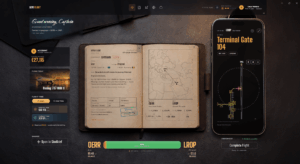
This philosophy also explains some of Veya’s more unusual features. Alongside its contracts and flight tracking, the application includes dispatchers, paperwork, payslips, hotels and meal vouchers, all intended to give the impression of a working pilot’s life.
These details aren’t necessarily the main attraction, but they help create an atmosphere around each assignment. Ghost Dragon compares them to seasoning in a dish: they add character without needing to dominate the experience. He has also taken considerable care over how information is presented, using vintage-style maps, documents, subdued lighting and other visual elements to create something closer to a dispatcher’s desk than a conventional software dashboard.
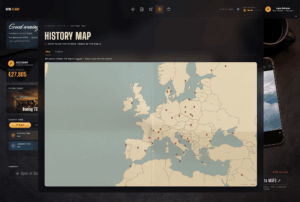
From Image Retouching to Software Development Perhaps one of the most interesting parts of Ghost Dragon’s story is that he doesn’t come from a traditional software development background. For the past 20 years, he has worked as an image retoucher, and he readily admits that he isn’t a programmer. Instead, he has developed Veya Flight using AI-assisted coding, working with Claude to help turn his ideas into a functioning application. Although the programming approach may be relatively new, his experience with visual design has played an important role in shaping the finished product. From the earliest stages of development, he had a clear idea of how Veya should look and feel.
The imagery, music, narration, animation transitions and even the positioning of aircraft within the application’s thumbnails have all received careful attention. For Ghost Dragon, presentation is not simply about making software look attractive. It’s about helping the user become immersed in the experience without making the application unnecessarily complicated.
There’s also more happening behind the scenes than is immediately visible. He has already developed elements of a crew duty-time monitoring and planning system, although these are not currently exposed as a full gameplay feature. Other details that presently contribute mainly to the atmosphere may eventually become part of the experience itself. He’s understandably keeping some of those ideas to himself for now.
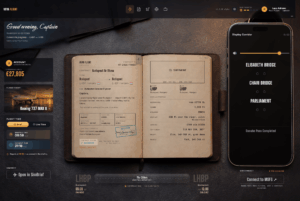
While Veya’s contracts provide the foundation for everyday flying, Ghost Dragon has also been experimenting with more carefully constructed story missions. One that he particularly enjoyed developing was inspired by a real-world Airbus demonstration flight over the River Danube in Budapest. Rather than simply creating a route between two airports, he wanted to recreate the experience of flying the demonstration itself. This involved researching the original flight, gathering information about speeds, altitudes and navigation points, and then reproducing the manoeuvres within Microsoft Flight Simulator. The mission includes a briefing, map, narration and music, with the audio timed to follow the progress of the flight. Players can take control of their own aircraft and attempt the route themselves, including the low-level passes along the Danube and the return to Budapest Airport.
It’s a rather different experience from a conventional airline flight, and one that requires the pilot to get involved rather than simply follow a route using the autopilot. For Ghost Dragon, that was precisely the point. He wanted to create something that people could experience from the flight deck, rather than simply watch as a cinematic sequence. The mission also demonstrates how Veya Flight could develop beyond a straightforward contract system, using storytelling and real aviation events to introduce new experiences within the simulator.
A Project Shaped by Its Community Although Veya Flight began as a personal project, its direction has increasingly been influenced by the people using it. Ghost Dragon has been actively responding to feedback, fixing reported issues and considering suggestions that weren’t necessarily part of his original plans. Requests from users have already encouraged him to introduce business jets, ATR-class aircraft and additional airlines from Asia. He admits that some of these additions weren’t areas he had originally intended to explore, but listening to the community encouraged him to reconsider what the application could offer.
He has also made an important decision about how Veya Flight will be distributed. Having previously considered different versions of the application, Ghost Dragon has now confirmed that Veya Flight is available as a single, completely free version, with all features included.
Living in Germany, he explains that turning the project into a commercial product would involve business registration and administrative responsibilities that he doesn’t currently want to take on. For now, he’d rather concentrate on developing Veya, responding to feedback and allowing other flight simmers to enjoy what he’s creating. That approach has given him the freedom to continue experimenting with the application without the additional pressures of running a commercial software business.
Ghost Dragon has also shared an early preview with AvGeekHangar of a new feature he’s preparing to introduce to Veya Flight: an interactive airport map designed to make navigating unfamiliar airports a little easier. The feature will give pilots a clearer overview of their aircraft’s position, the route they need to follow and where they should park at the end of their flight. Anyone who has arrived at an unfamiliar airport and struggled to find the correct taxi route or parking location will appreciate the thinking behind it. Rather than having to search for an airport chart or work through additional menus, Ghost Dragon wants the relevant information to be presented automatically, helping pilots understand where they are and where they need to go.
It’s another example of his approach to developing Veya Flight: providing useful information without introducing unnecessary complexity or distracting pilots from the simulator itself. The new feature is planned for release following publication of this article, and Ghost Dragon has kindly given AvGeekHangar an opportunity to share an early look at what he’s been working on.
When we asked Ghost Dragon what advice he would give to other flight simmers thinking about developing their own applications, his response was particularly fitting. “Create for people, not for features.” It’s a simple principle, but one that runs throughout his approach to Veya Flight. He believes that even complicated systems can be presented in a way that feels clear, practical and enjoyable, and that the technical side of an application shouldn’t come at the expense of the experience itself.
There’s also something rather appealing about the fact that Veya began with such a familiar problem. Ghost Dragon wasn’t trying to reinvent Microsoft Flight Simulator or build the most complicated career application available. He simply wanted to stop staring at the world map and wondering where to fly next. From a childhood memory of Airline Tycoon to discovering unfamiliar airports and developing his own software, that idea has grown into something he can now share with the wider flight simulation community. And for those of us who occasionally struggle to decide where our next flight should take us, perhaps having someone else provide a reason to depart isn’t such a bad idea.
Discover Veya Flight Veya Flight is available completely free through Flightsim.to, with all features included.
Visit Veya Flight on Flightsim.to
Our thanks to Ghost Dragon for taking the time to share the story behind Veya Flight, for giving AvGeekHangar an insight into his development process and for sharing an early preview of his forthcoming airport map feature.